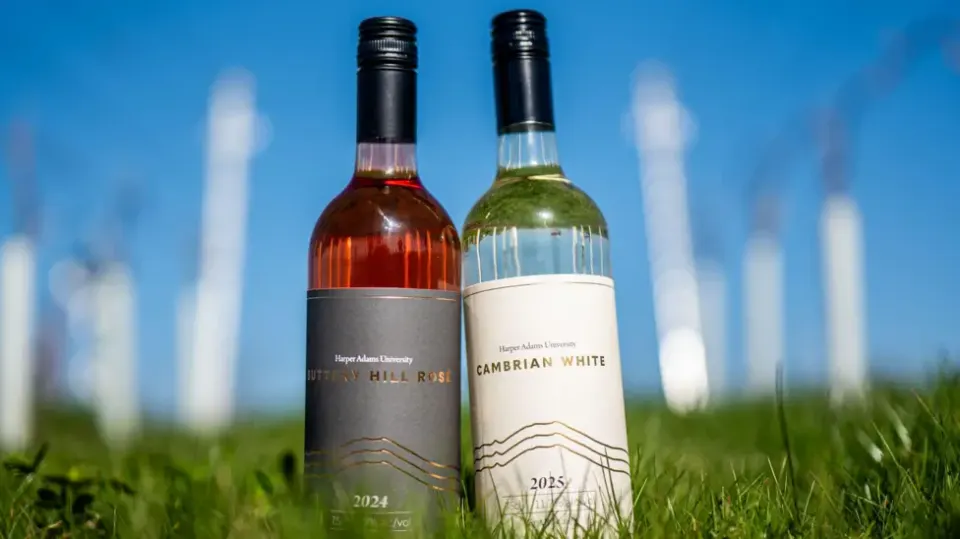
In my first week at Harper Adams University, I found myself drawn to its burgeoning vineyard projects. Given my background in the wine industry, the work being done here resonated deeply. To say I was impressed would be an understatement. Harper Adams is undertaking work that could very well be Shropshire’s best-kept secret, with the potential to shape the future of the British wine industry.
The university’s vineyard serves multiple purposes: it is a centre for cool climate viticulture research, a hub for engineering and automation, and a crucial example of farm-diversification opportunities. The innovations being explored here are setting the foundation for the future of one of the fastest-growing agricultural sectors in the country. From advances in automation to strategic research on climate resilience, Harper Adams’ work could mark a significant turning point for British wine.
The site not only serves academic and scientific purposes but also invites existing farmers to consider viticulture as a diversification opportunity, bridging tradition with modern possibilities. Alumni from Harper Adams are already deeply entrenched in the global wine industry, from New Zealand to vineyards across the UK, demonstrating how this university is producing leaders and changemakers in every aspect of the value chain.
Harper Adams is also collaborating with local pioneers like Martin Vickers from Halfpenny Green, who has been growing grapes in the region for decades. They planted over 3,500 vines, including both traditional and newer varieties such as Bacchus, Chardonnay, and Pinot Noir, alongside the disease-resistant PIWI varieties like Cabaret Noir and Divico. The vineyard’s strategic layout (with variations in orientation and a section specifically chosen for its vulnerability to spring frost) enhances its utility for both research and teaching purposes, preparing students to handle the real challenges of cool climate viticulture.
The university’s vision does not end here. Harper Adams intends to expand its plantings further, aligning the vineyard with new market varieties and embracing collaborations with academic and industry partners to pioneer cutting-edge technologies in both viticulture and winemaking practices.
They are also set to launch a diverse selection of courses, spanning BSc and Master’s levels to practical, hands-on modules that address everything from grape production to the business side of the wine industry. This holistic approach makes Harper Adams a hub for the next wave of innovation in British wine.
The state of the UK wine industry: challenges and growth
The UK wine industry is at a crossroads, experiencing rapid growth despite facing inherent challenges tied to climate and consumer behaviour. As of July 2024, there were over 1,000 vineyards across the country, reflecting nearly a 10% increase from the previous year and a staggering 123% increase over the last decade. With sales nearing 10 million bottles in 2023, the appetite for English and Welsh wines has never been stronger. Sparkling wines dominate this landscape, making up 76% of total production, a testament to the success of the traditional method in the UK’s climate.
Still wines, although accounting for just 23% of production, have seen a 117% increase in sales since 2018, indicating a growing market. The industry is also diversifying its grape varieties; over 90 are now cultivated across the UK, including hybrids that account for 8% of plantings, offering a broader palette of wine styles. However, the unpredictable British summer adds a layer of risk. The bumper crop of 2023, which led to an estimated production of 21 million bottles, sharply contrasts with the 2024 season, where yields are expected to drop by as much as 70%.
Financial pressures

This variability in production poses significant risks to the financial stability of wineries, particularly those dependent on premium wine sales. Chapel Down, one of the UK’s best-known wine producers, has faced a difficult year. The company anticipates up to a 70% reduction in grape yield, translating to financial losses and projected revenue declines. Compounding these challenges, CEO Andrew Carter announced his departure in September 2024, adding further uncertainty to Chapel Down’s future.
Despite these setbacks, English sparkling wines continue to garner international acclaim, often likened to Champagne in terms of quality. However, reliance on bottle sales as the primary revenue stream is increasingly risky, especially in light of declining Champagne sales this year, driven by global economic uncertainties and a drop in consumer spending on premium products. The favourable terroir in regions like Kent and Sussex, coupled with investment from major players like Champagne house Taittinger, underscores the growing belief in the potential of British sparkling wine, but it also highlights the vulnerabilities faced by producers reliant on a premium segment with fluctuating demand.
The tourism opportunity: a billion-pound vision

Beyond production, the UK’s wine industry holds substantial untapped potential in wine tourism. In 2023, UK vineyards and wineries attracted 1.5 million visitors, a 55% increase from the previous year. In contrast to the risky dependence on bottle sales, the future of wine tourism looks even more promising: estimates suggest up to 20 million annual visits could be achievable in the next decade, generating nearly £1 billion in revenue.
To reach this level of growth, however, the sector will need to innovate beyond the bottle. Tastings, food pairings, on-site events, and accommodation are all critical components of a thriving wine tourism experience. WineGB has also outlined seven actions to boost this growth, from introducing cellar door tax relief to improving rural infrastructure and making destination signposting more accessible.
The challenges are undeniable: variable harvests, economic pressures, shifting consumer preferences. But so are the opportunities. Harper Adams University, with its pioneering vineyard projects and commitment to education, is well-positioned to be a key player in addressing these challenges and seizing these opportunities. What is happening in the fields of Shropshire is more than just an experiment; it is building a resilient future for British wine.

Farmer, manufacturer, winemaker and restaurateur across three food systems. He writes Planet Earth Rise twice a month. About Mel →